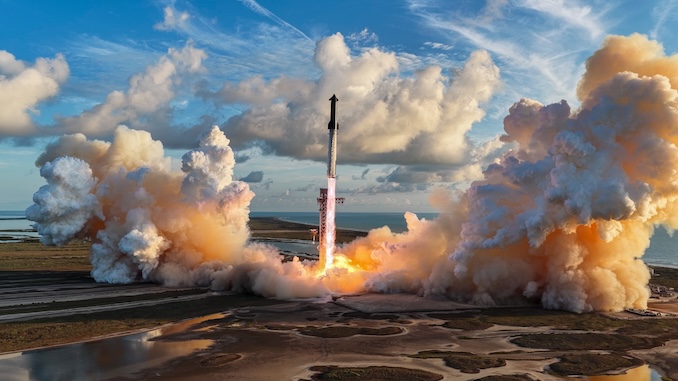
Starship returns to Earth; rocket splashes down north of Hawaii after three-hour flight
The Super Heavy first stage booster, generating some 16 million pounds of thrust — twice the power of NASA's Space Launch System moon rocket — rapidly accelerated as it consumed propellant and lost weight, climbing out of the thick lower atmosphere along a southeasterly trajector
SpaceX’s Starship-Super Heavy rocket lifts off from Pad 2 at Starbase, Texas, to begin the Starship Flight 14 mission. Image: SpaceX With thirteen suborbital test flights behind them, SpaceX engineers launched the company’s Super Heavy-Starship on its first flight to orbit Monday, a major step toward perfecting the world’s most powerful rocket for commercial flights and NASA moon missions. One of the Starship upper stage’s six Raptor engines shut down early during the climb to an initially suborbital trajectory. After assessing telemetry, Elon Musk’s flight control team decided the spacecraft was otherwise healthy and a second engine firing using a single Raptor engine completed the climb to orbit. Right after that, the Starship upper stage deployed 26 third-generation Starlink internet satellites that will join the company’s ever growing constellation in the first use of the new rocket to launch operational satellites in low-Earth orbit. After the satellites were away, SpaceX controllers opted to bring the Starship back to Earth well ahead of schedule, ending the mission three hours after launch with a Pacific Ocean splashdown north of Hawaii. Dawn breaks over the Pacific Ocean north of Hawaii as the Starship approaches splashdown. Image: SpaceX For NASA, getting the Starship into orbit and back were critical steps on the road to perfecting the system in time to support a planned Artemis moon landing, using a variant of the Starship, in 2028. A future moon mission will require multiple Super Heavy-Starship tanker flights to fuel the lander for its flight to the moon before docking with a NASA Orion crew capsule in lunar orbit, picking up two astronauts and carrying them down to the surface and back. “Congrats @SpaceX!,” NASA Administrator Jared Isaacman said in a post on the social media platform X. “Gorgeous launch, getting Ship to orbit and managing every step in a safe, responsible, and especially inspirational way. @NASA, along with the rest of the interested public, is excited to help where we can and for Starship missions to become routine!” Few doubt SpaceX will eventually get the Super Heavy-Starship flying reliably, but it’s not yet known whether the company will be able to meet NASA’s ambitious 2028 target date for the Artemis IV moon landing. In any case, Monday’s mission got off to a spectacular start. The Super Heavy booster’s 33 methane-burning Raptor engines ignited with a rush of flame at 8:49 a.m. EDT, quickly propelling the 400-foot-tall rocket away from SpaceX’s Starbase launch site on the Texas Gulf Coast. The Super Heavy first stage booster, generating some 16 million pounds of thrust — twice the power of NASA’s Space Launch System moon rocket — rapidly accelerated as it consumed propellant and lost weight, climbing out of the thick lower atmosphere along a southeasterly trajectory. One of the engines shut down early, but the rocket was designed to reach space despite the loss of a few engines. Two minutes and 20 seconds after liftoff, the rest of the first stage engines began shutting down while the six Raptors powering the Starship upper stage began firing up in a “hot staging” maneuver seconds before the the booster separated and fell away. While the Starship continued toward space, the Super Heavy booster flipped around, restarted its engines to reverse course and then flew itself back to the Texas Gulf Coast. A second engine apparently shut down early during the so-called boost-back burn, but the huge rocket was able to execute a seemingly normal vertical splashdown a few miles off shore. During the most recent previous test flight, three engines suffered problems that prevented a full-duration boost-back burn and only eight of 13 engines fired for the landing burn. The result was a “hard” splashdown. SpaceX implemented multiple upgrades and software changes to ensure a successful return this time around. The first stage is designed to be captured by giant mechanical arms on its launch gantry, a feat