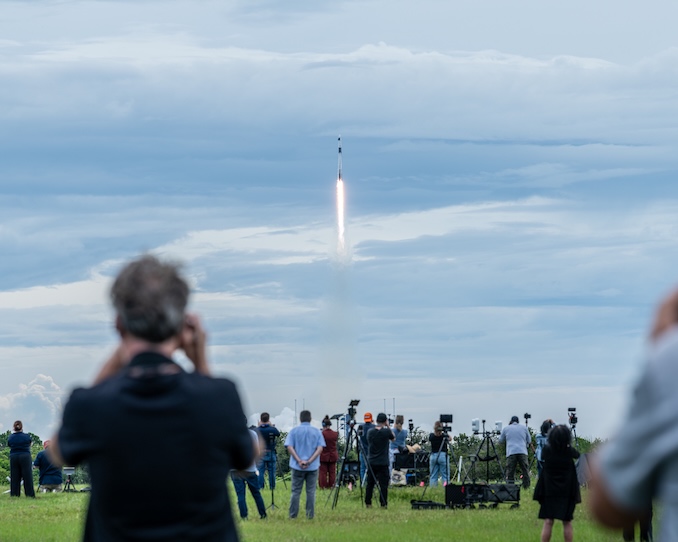
Fresh crew takes off for six-month stay aboard space station
Strapped into a SpaceX Crew Dragon capsule, Crew 13 commander Jessica Watkins, pilot Luke Delaney, Russian cosmonaut Sergey Teteryatnikov and Canadian astronaut Joshua Kutryk blasted off from pad 40 at the Cape Canaveral Space Force Station at 11:10 a.m. EDT.
A SpaceX Falcon 9 rocket lifts off from Space Launch Complex 40 at Cape Canaveral Space Force Station to begin NASA’s SpaceX Crew-13 on Oct. 1, 2026. Image: John Pisani/Spaceflight Now A SpaceX Falcon 9 rocket took off on a flight to the International Space Station Thursday carrying two NASA astronauts, a cosmonaut and a Canadian whose wife plans a launch of her own later this year, giving birth to the couple’s third child while her husband is away in space. Strapped into a SpaceX Crew Dragon capsule, Crew 13 commander Jessica Watkins, pilot Luke Delaney, Russian cosmonaut Sergey Teteryatnikov and Canadian astronaut Joshua Kutryk blasted off from pad 40 at the Cape Canaveral Space Force Station at 11:10 a.m. EDT. The launch originally was planned for mid September, but the flight was delayed to replace a leaking valve in the Crew Dragon’s propulsion system. Watkins, who holds a Ph.D. in geology, flew to space aboard a Crew Dragon in 2022. Her crewmates are space rookies, the 296th, 297th and 298th astronauts to fly aboard the ISS. Delaney and Kutryk are both former military test pilots while Teteryatnikov served in the Russian submarine force before becoming a cosmonaut. The four members of NASA’s SpaceX Crew-13 mission exit the Neil A. Armstrong Operations and Checkouts Building the Kennedy Space Center to bid farewell to their friends and families. Left to right: Canadian Space Agency (CSA) astronaut Joshua Kutryk, NASA astronaut Luke Delaney, NASA astronaut Jessica Watkins, and Roscosmos cosmonaut Sergey Teteryatnikov. Image: Michael Cain/Spaceflight Now Kutryk and his wife Heather have two children, ages 5 and 7. They’re expecting their third child around Thanksgiving, about two months into the Crew 13 mission. In so doing, they will become the fourth couple in space history to have a child born while one parent was off the planet. “Leaving these three (plus one on the way) is the hardest thing I’ve ever done,” Kutryk wrote in a post on the social media platform X. “But that has always been the nature of exploration.” He then quoted Norwegian arctic explorer Fridtjof Nansen, describing his thoughts upon setting off for the North Pole. “‘Behind me lay all I held dear in life. And what lay before me? Happy child, little do you know what life is — how strangely mingled and how full of change… and now, a farewell to home. It was the darkest hour of the whole journey.'” Canadian Space Agency (CSA) astronaut Joshua Kutryk (in vehicle) is photographed by another CSA astronaut alongside his wife, Heather, and their two children. The couple are expecting their third child to be born while Kutryk is on orbit. Image: Michael Cain/Spaceflight Now Despite President Trump’s recent animosity toward Canada, the Canadian Space Agency continues to play a major role in the U.S. space program. Along with supplying the robot arms that helped build the space station, CSA astronaut Jeremy Hansen flew around the moon on NASA’s Artemis II mission. Kutryk is the 17th Canadian to fly in space. “When I think about the space station, I hope the legacy is that people see this beacon in the sky going around Earth, one of the most complex things humans have ever, ever created, and they see it for all of its technical marvel and all the science and discoveries we’re making there,” he said. “But (I hope) they also see it as sort of this beacon for what we can do when we make good decisions, when we work together and we collaborate and we prioritize things. It’s testament to what we’ve done, what we can do, and really to what we hope the generations that follow can do.” After boosting the Falcon 9 and Crew Dragon capsule out of the dense lower atmosphere, the Falcon 9’s first stage flew itself back to a pinpoint landing at the Space Force station while the rocket’s upper stage continued the climb to space. Minutes later, the second stage engine shut down and the crew capsule separated to fly on its own. “What an epic ride!” Delaney radioed. “What an epic ri